| Roger Keagle's Complied History of Canton, Bradford County PA |
|
Ghost Towns Near Canton
Thomas T. Taber Pennsylvania, [Penn’s Woods] was heavily wooded when the first white settlers arrived. They used the trees to build homes and barns and cleared enough land to grow crops, but this hardly made a dent in the total number of trees. In the early 1800’s, the woods started to be lumbered off, and the rivers were used in the spring of the year to move the logs to a mill. Williamsport became known as the “Lumber Capital of America” because of the large number of logs floated down the east branch and the west branch of the Susquehanna river to the mills there. When steam engines began to be widely used, it opened up a new era in lumbering. Railroads could be built into the woods making it much easier to bring the logs out, and sawmills could be constructed where there was enough flat land. With many square miles of virgin timber available, many different lumber companies were eager to reap this harvest. Masten and Laquin were two lumbering towns created solely to exploit the lumber available in the area. Laquin was first started in 1902, and the mill started operating in 1903. It was located midway between Wheelerville and Powell. Over 1,000 people lived there at one time. It had a sawmill, a chemical factory which made acetate of lime, wood alcohol and charcoal. The sawmill could saw 135,000 board feet a day, and eventually cut twenty square miles of timber before closing operations. The working day was eleven hours a day. There was an engine terminal at Ellenton. Masten was started about 1905. It had ninety homes, a hotel and a boarding house for unmarried men. It had a hemlock mill which could cut 70,000 board feet a day, a hardwood mill which could cut 40,000 board feet a day, a clothes fin factory and a lath mill. The hemlock logs were stripped of their bard, and this was sent to Powell and other tanneries in the area. The Masten operation lasted for twenty five years. The last log was cut September 18, 1930, but it took another three years to ship out all of the lumber that had been cut. During the depression, a Civilian Conservation Corps Camp was built there, and it closed in 1940. The last family moved out of Masten in 1941.
|
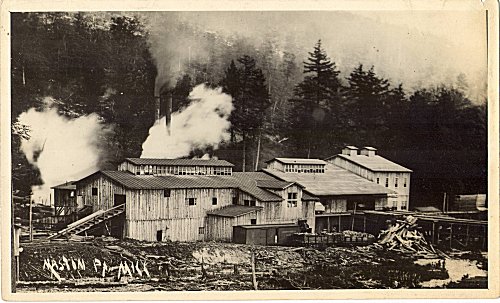
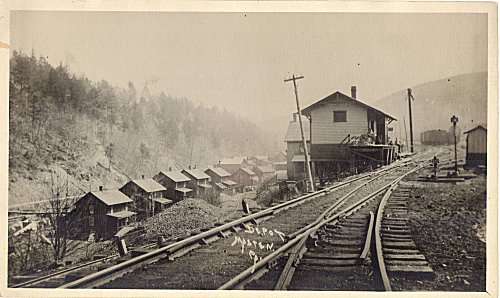
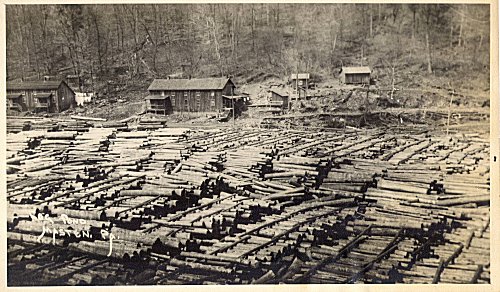
Because both Masten and Laquin were located in narrow valleys, just enough room for a sawmill and a few homes, and was isolated from other large towns, it made a poor location for a permanent town. Today, all that remains of both mill towns, are a few hunting lodges and summer homes.
Bibliography: Ghost Lumbering Town of Central Pennsylvania; Thomas T. Taber